

The Road to Recovery
The toxic drug crisis in British Columbia continues to be a significant public health emergency that has claimed the lives of more than 18,000 people since it was declared in 2016, alongside significant harms related to other substances, notably alcohol. Amid this crisis, demand for substance use services – from withdrawal management (detox) to treatment and aftercare services – continues to grow.
For many people, accessing timely, culturally safe, and evidence-based treatment and recovery services has involved navigating a complex and fragmented system with multiple entry points, long wait lists, and insufficient long-term supports – all of which can leave them without care at critical times.
To address this need, the Province of British Columbia launched Road to Recovery in 2023, a made-in-B.C. model of addiction care that is changing the way people access substance use services, making it easier for people to access the right care for their needs.
Developing the Road to Recovery Model
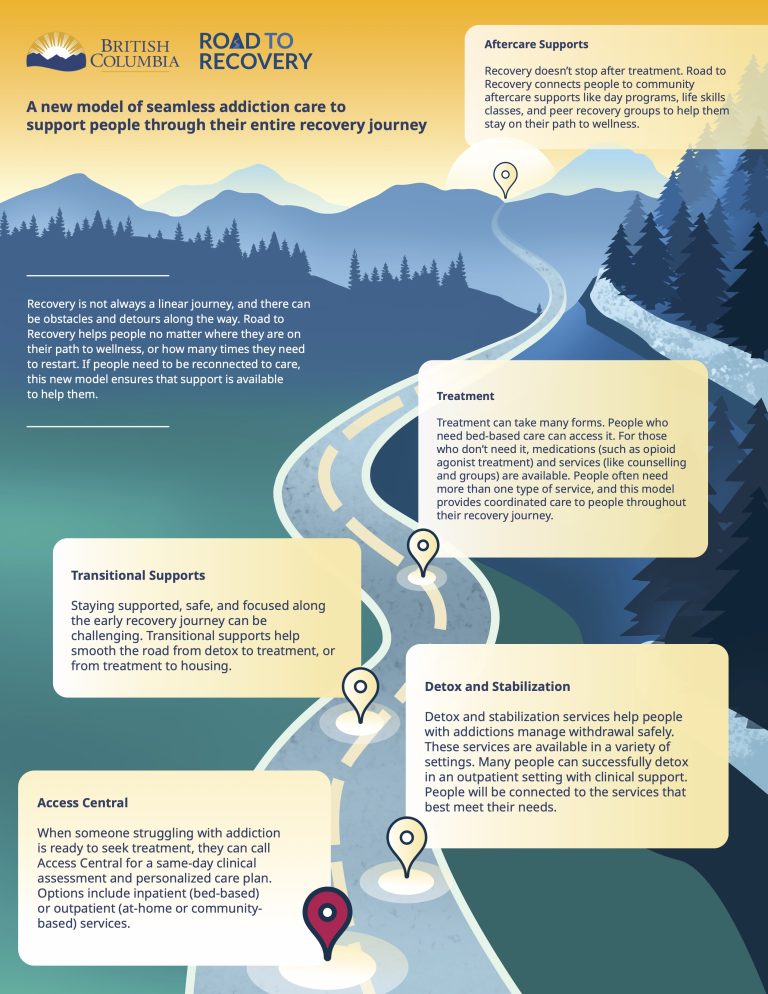
Road to Recovery is a coordinated model of substance use care that provides seamless, low-barrier support across all stages of a person’s recovery. Recognizing that recovery is often non-linear, the Road to Recovery model is designed to support people wherever they are in their recovery journey, and provides coordinated transitions between services, including access and assessment, withdrawal management (detox), stabilization, treatment, and aftercare.
The model was initially launched in 2023 at St. Paul’s Hospital in Vancouver by Providence Health Care’s Division of Addiction, the BC Centre on Substance Use, and Vancouver Coastal Health, with the support of the Diamond Foundation, the Ronald S. Roadburg Foundation, Peter Bull & Blenheim Foundation, and ongoing financial support from the Province of British Columbia. These investments created 25 acute withdrawal management beds, and 20 transitional stay beds at St. Paul’s Hospital. Planning is underway for additional treatment and recovery beds in Vancouver Coastal Health.
Vancouver Coastal Health was the first regional health authority to implement Road to Recovery. Across the Vancouver Coastal Health region, implementation has focused on transforming the “front door” to substance use services through Access Central, a new clinical service that provides a single point of entry to substance use services, including same-day clinical screening and assessment and personalized substance use care plan. The centralized and coordinated intake model reduced wait times for services to about 24-48 hours for those clinically assessed as most urgent, compared to the previous average wait time of three to four weeks.
Access Central operates within Vancouver Coastal Health’s broader, integrated system of care, which includes withdrawal management (detox) and stabilization beds, rapid access outpatient services, transitional and aftercare supports, and community-based recovery programming. Together, these services work to build a more coordinated continuum of care.
Collaboration between Providence Health Care, Vancouver Coastal Health, the BC Centre on Substance Use, the University of British Columbia, Indigenous partners, and individuals with lived and living experience has been essential for the regional implementation in the Vancouver Coastal Health region.
The continued development of the Road to Recovery is guided by the Provincial Addiction Recovery Treatment and Support Network, which brings together clinical and operational leaders from each regional Health Authority, First Nations Health Authority, the Provincial Health Services Authority, the BC Centre on Substance Use and the Ministry of Health to plan and improve the adult substance use system of care.
Expanding Road to Recovery Provincially
The goals of the model are:
- Timely and Simplified Access: Single access point in each region for same day clinical assessment, care planning, and treatment initiation.
- Right Care, Right Setting: People matched to service based on medical need and Health Authority coordinates referrals to service.
- Client Engagement and Continuity: Care planning at initial point of contact and care teams supporting transitions in care.
Road to Recovery is now being expanded to every health region in the province, and the expansion includes:
- A single-access line in each region to get connected to same day clinical assessment and addictions care (Access Central).
- New substance use treatment and recovery beds across the province.
- New or expanded outpatient, community-based services.
Expansion of Access Central across B.C. is an important first step towards a seamless province-wide continuum of care for addictions. Access Central helps adults connect to addictions care through a single phone line in each available region. First launched in Greater Vancouver in 2023, the service is now available in the Fraser Health, Interior Health and Island Health regions. In the future, people in the Northern Health region will also be able to use an Access Central phone line, expanding the service province wide.
Vancouver Coastal Health
• People in the Vancouver Coastal Health region can contact Access Central seven days a week from 9:00 a.m. to 7:45 p.m. by calling 1-866-658-1221.
Fraser Health
• People in the Fraser Health region can contact Access Central seven days a week from 8:30 a.m. to 8:30 p.m. by calling 1-833-866-6478.
• Individuals can also self-refer and request a call back through Fraser Health's Digital Front Door.
Interior Health
• People in the Interior Health region can contact Access Central seven days a week from 9:00 a.m. to 4:30 p.m. through the toll-free number 1-866-777-1103.
Island Health
• People in the Island Health region can contact Access Central seven days a week from 8:30a.m. to 8:30 p.m. by calling 1-888-885-8824.
Our Role in Evaluation and Continuous Improvement
In addition to co-developing the vision for Road to Recovery, the BC Centre on Substance Use supports the success of Road to Recovery by contributing to standardized practice supports and protocols, supporting training for health professionals, and informing research and evaluation activities related to the Vancouver model, in alignment with broader provincial monitoring and evaluation efforts.
The primary objectives of research and evaluation of Road to Recovery are to:
- Evaluate health and social outcomes among people who access Road to Recovery, including substance use trends, quality of life, and health care utilization patterns.
- Determine the effectiveness of Road to Recovery.
- Capture patient experiences and satisfaction with Road to Recovery services, to identify opportunities for improvement, and understand how access to these new services impact a patient’s addiction treatment trajectory.
- Use data to inform Road to Recovery clinical service delivery in real time for ongoing quality improvement and innovation.
Through structured measurement and shared learning, the partners seek to contribute to broader knowledge on integrated addiction care at provincial, national, and international levels.
R2R In the News
-
- This Vancouver hospital is transforming addiction treatment (White Coat Black Art, CBC)
- Detox wait times plummet after B.C. innovates drug treatment intake (CTV)
- BC building historic treatment, recovery services for people struggling with addiction (BC Gov News)
- More Treatment, Recovery Services Coming for People Struggling with Addiction (The Daily Scan, PHC)